The Mental Capacity Drain Cascade: How One Small Annoyance Turns into Burnout
By BrioMon Team

You can wake up burned out.
What you can't do is get there in one bad Tuesday — by the time exhaustion is big enough to have a name, it's already been building for weeks, through something so small, so easy to wave off, that almost nobody ever stops to name it at the moment it actually starts.
Here's where it actually starts: a notification lands at the wrong moment. A colleague talks too loudly two desks over. A meeting runs fifteen minutes past when it should have ended. None of these are a crisis. None of them would make it into a status report. But each one takes a small bite out of your mind's usable capacity — the same fixed, occupiable space we've talked about before, the one that works a lot like your computer's RAM. And what happens next, if nothing interrupts it, isn't random. It follows a pattern — a cascade — that's consistent enough to actually name and catch, once you know what you're looking for.
1. Annoyance — the seed, and the only stage that's nearly free to clear
Annoyance is the gap between what your mind expected and what it actually got, and the mind not quite being able to let it go. It's quiet. It's small. It's also the cheapest point in the entire cascade to interrupt — thirty seconds, maybe less. Almost nobody spends those thirty seconds, because almost nobody recognizes annoyance as something worth spending thirty seconds on. That's exactly how it gets a foothold.
2. Irritability — annoyance that never got cleared, repeating
Leave a handful of annoyances unaddressed through a morning, and something shifts: the next thing that would normally roll off you doesn't. Your patience for ordinary friction — a slow reply, a repeated question, a small delay — gets shorter, and you probably can't point to any single cause. That's because there usually isn't one. It's accumulation, not a single trigger, and it's the reason a person can seem “fine” all morning and noticeably sharper by 2 p.m. without anything dramatic actually happening.
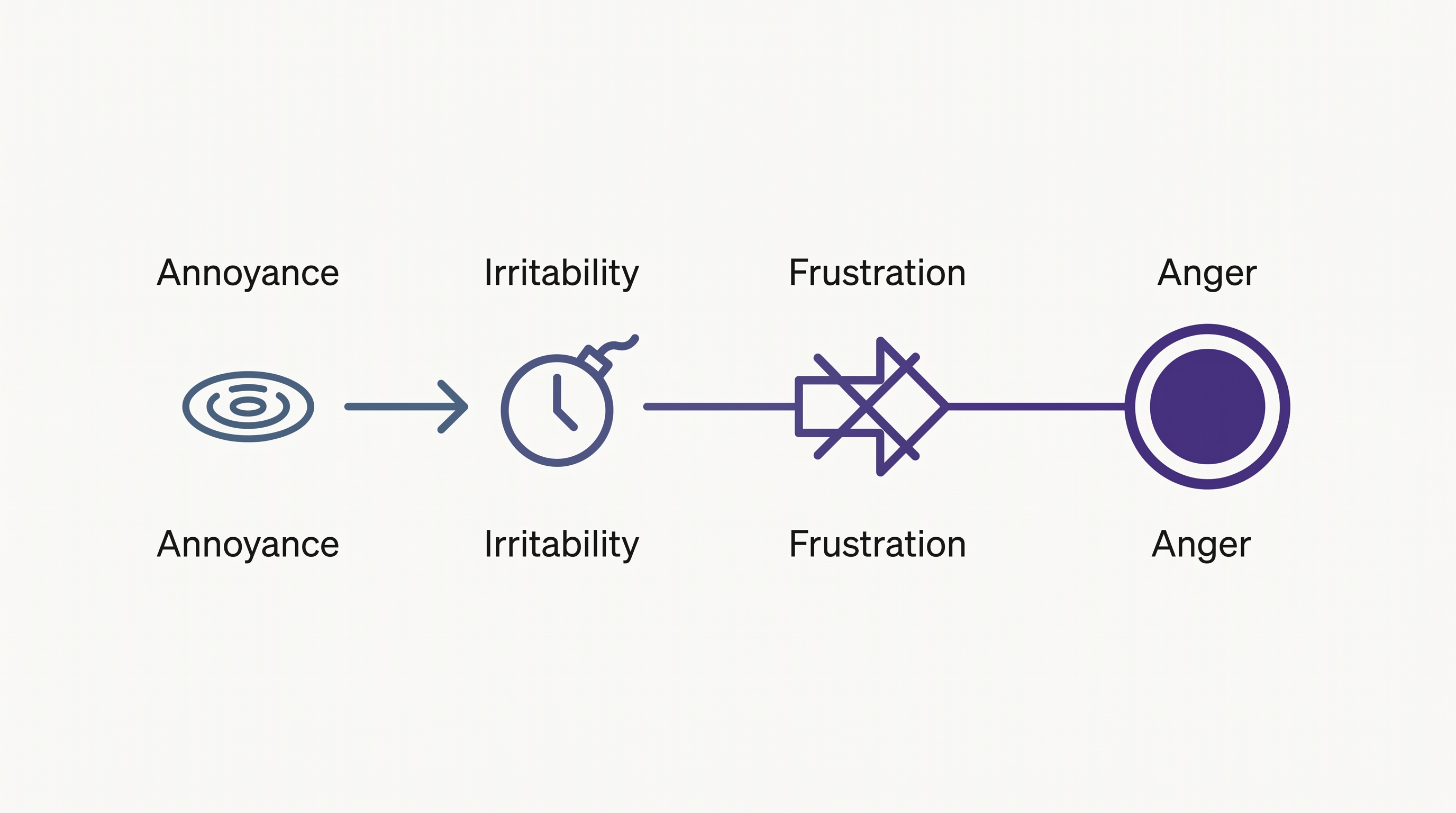
3. Frustration — annoyance meeting something you can't get past
This is where it stops being purely internal and starts showing up in your work. A task that won't cooperate. A plan that keeps hitting the same obstacle. Frustration is what irritability looks like once it collides with an actual barrier — and this is usually the first stage a colleague or manager can actually see, in shorter replies, visible tension, small mistakes that wouldn't normally happen.
4. Anger — full activation
By this stage, thinking has gotten reactive rather than considered. This is the outburst, the terse message sent without rereading it, the decision made in the heat of the moment that gets walked back later. It's also, not coincidentally, the stage everyone finally notices — because it's the loudest. But it was never the start. It was the fourth stop on a route that began with something as small as a notification sound.
5. Burnout — the system's own shutdown
Burnout isn't a single collapse. It's what happens after this cycle repeats often enough, for long enough, without ever being interrupted upstream — the mind's own way of disengaging to protect itself once it's been running hot for too long. Apathy where there used to be investment. Exhaustion that sleep doesn't fully touch. A sense of disconnection from work that used to matter to you. This is the expensive end of the cascade — and it's also the one everyone tries to treat directly, with time off, with a break, with “just rest” — when the actual leverage point was five stages back, at a notification sound nobody thought was worth thirty seconds.
That's the whole point of naming the cascade: every stage in it is interruptible, but the cost of interrupting it rises sharply the further along it you are. Catching annoyance takes thirty seconds. Recovering from burnout takes months. The gap between those two numbers is the entire argument for learning to catch this early instead of waiting for it to become undeniable.

Two things help at the earliest, cheapest point in the chain, and both are backed by real research rather than general wellness advice. The first is simply naming what you're feeling — silently, to yourself, in the moment: I notice I'm annoyed right now. A 2007 UCLA study led by Matthew Lieberman found that labeling an emotion in words measurably reduces activity in the brain's alarm response and brings rational thinking back online — a finding that's been replicated enough times since to be considered solid. The second is one long, slow exhale — breathing out for roughly twice as long as you breathe in. Multiple studies on slow-paced breathing have confirmed this directly activates the body's calming nervous-system pathway and begins lowering physiological stress within a single breath cycle. Neither of these takes more than a few seconds. Both work at exactly the stage where working is still cheap.
And if you lead a team, this cascade is worth mapping onto the people around you, not just yourself. The colleague who seems a little sharper than usual by afternoon isn't necessarily having a bad day — they may be three or four unnoticed annoyances into a cascade nobody, including them, has named. The team member whose small mistakes are creeping up isn't necessarily losing skill — they may be at frustration, not incompetence. Catching this early, in yourself or in the people you're responsible for, is dramatically cheaper than managing what it becomes if it runs the full five stages unchecked.
If it's your own days you're picturing running this pattern — Request a Trial, and start learning to catch it at stage one, before it costs you the rest of the week.
If it's your team you're responsible for, and you're seeing frustration or disengagement without a clear cause — Request Access, and see how catching this cascade early gets applied across the people you lead.